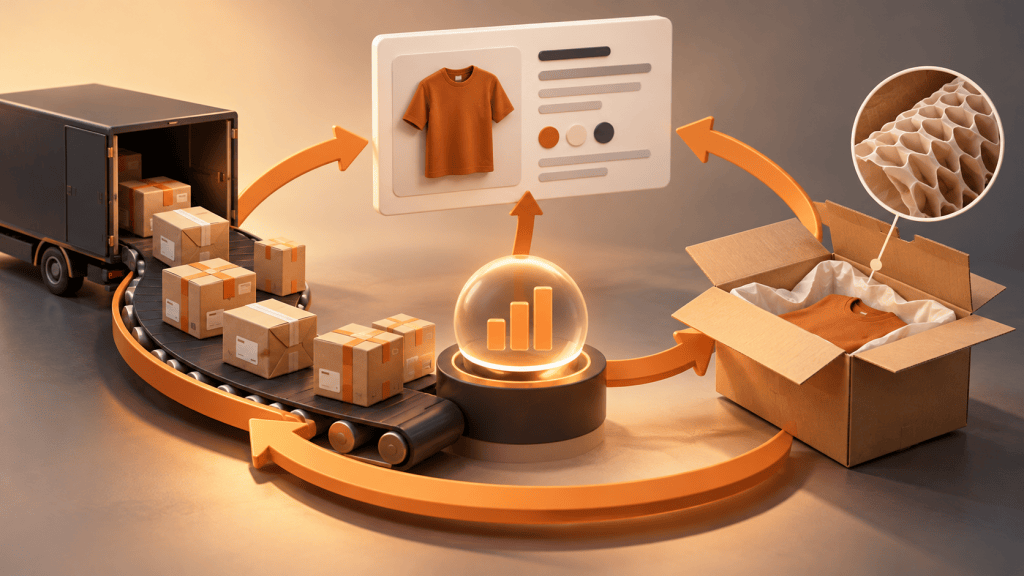
Featured image: AI-generated conceptual illustration. Sources checked 26 October 2026.
Returns contain useful information about products, descriptions, packaging, and fulfillment. They also contain ambiguity. A customer may choose the nearest available reason code, describe several problems at once, or omit details. An AI system can help organize this evidence, but it should not turn uncertain interpretation into an automatic denial of service.
The proposed business is a returns-intelligence report with an action-tracking retainer. It aggregates authorized data, identifies plausible patterns, and helps operations teams test improvements. It does not decide whether individual customers deserve refunds, and it should not build punitive profiles from speculative conclusions.
Separate stated facts from inference
Preserve the customer's stated reason and any verified operational facts. If the customer says an item was too small, that is evidence about their experience. It does not by itself prove that the size chart is wrong, that the item was mislabeled, or that the customer made an error.
Store inferred themes separately from source text. A model might classify a comment as a possible sizing issue, but that label should remain reviewable. Distinguish “customer reported damage” from “packaging caused damage,” which is a causal hypothesis requiring more evidence.
Keep the analysis proportionate. Use the minimum personal information needed and aggregate where possible. Product and order context may be relevant; unrelated customer details usually are not. Follow the merchant's permissions and retention requirements before exporting records into an analysis system.
Build a useful taxonomy
Start with categories tied to possible operational actions: sizing guidance, unclear description, product quality, transit damage, incorrect item, delivery delay, and changed customer preference. Include an unknown category and allow multiple themes when the record supports them.
Have operations staff review a sample. The purpose is not to create an elaborate taxonomy for its own sake but to distinguish issues that different teams can investigate. If two categories always lead to the same action, they may not need to be separate.
Record changes to the taxonomy. A trend can appear to rise simply because the classification rules changed. Keep enough version information to compare like with like, and rerun historical samples where necessary to understand the effect.
Compare appropriate cohorts
Analyze returns relative to sales volume and product mix. Ten returns may be alarming for a product with 40 sales and ordinary for one with thousands. Raw counts are useful for workload planning but insufficient for product comparisons.
Group by relevant factors such as product variant, supplier batch, fulfillment route, or purchase period when the data supports it. Avoid slicing the data into tiny groups that generate dramatic but unstable percentages. Report small-sample uncertainty clearly.
Account for the return window. Recent orders have had less time to be returned than older ones. Comparing immature and mature cohorts without adjustment can make a new product look better than it is. State which periods have sufficiently complete outcomes.
Validate patterns before acting
If the model identifies a rise in “too small” comments for one garment, inspect sampled records, size-chart changes, supplier specifications, and fulfillment accuracy. The pattern may be real, but several causes are possible.
Ask the responsible team to confirm what can be tested. A listing clarification, packaging change, or additional quality check may be a reversible experiment. A broad product recall, policy restriction, or supplier termination requires a different level of evidence and authority.
Keep a hypothesis register: observed pattern, proposed explanation, supporting evidence, missing evidence, owner, and next test. This prevents a generated insight from becoming accepted organizational fact merely because it appeared in a polished report.
Close the operational loop
Assign actions and review dates. A monthly report that repeatedly identifies the same issue without an owner creates little value. The service should track whether the merchant applied the change and whether the intended outcome can be observed.
Measure the relevant result. If the change clarifies dimensions, examine returns associated with size expectations in comparable cohorts. If the change improves packaging, examine damage reports while considering shipping-route changes and seasonality.
Do not claim causation from every favorable movement. A lower return rate may reflect a promotion attracting different buyers or a shift in product mix. Where a controlled test is practical, use one. Otherwise present the result as observational and describe the limitations.
Keep customer decisions separate
Aggregate returns analysis should not silently become a customer-scoring system. Repeated returns can have legitimate explanations, and speculative labels can unfairly influence service. Any fraud or abuse process requires its own evidence standards, authority, and review.
The Shopify privacy documentation linked below is relevant platform guidance, not a complete legal analysis. If the service stores personal information or derived profiles, qualified review may be necessary for the actual jurisdiction and use case.
Make deletion and access controls part of the operation. Removing a customer record from the store may require corresponding action in copied datasets or indexes. Avoid retaining raw conversation text indefinitely simply because storage is cheap.
Price accountable analysis
A retainer can cover a defined number of products, records, review meetings, and tracked experiments. Include human validation time and data-quality work. The most expensive part may be resolving inconsistent records, not running the model.
Stop or narrow the service when the data cannot support reliable conclusions or the merchant has no capacity to act. The commercial value lies in better operational decisions and verified improvements, not in producing an impressive number of AI-generated insights.
Sources and evidence
Shopify privacy law compliance.
Research checked October 26, 2026. Business designs and illustrative calculations in this article are editorial proposals, not documented earnings or guarantees. Recheck current product terms before implementation.


Leave a Reply